
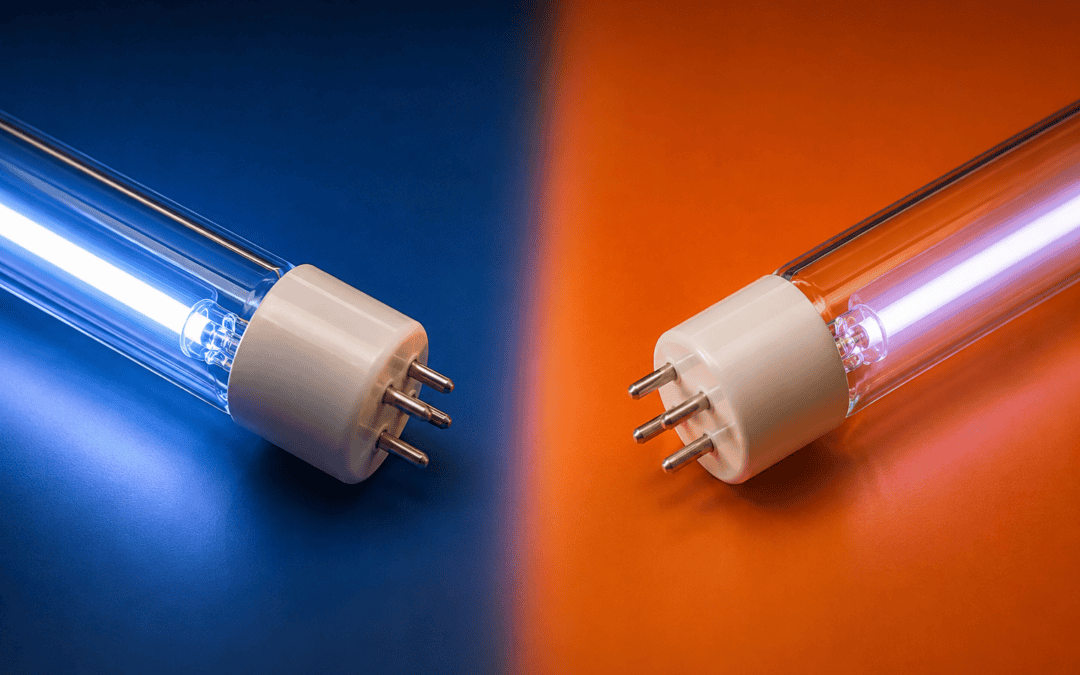
When comparing Philips vs Osram UV lamps, it is important to look beyond the brand name. Both manufacturers are associated with specialist ultraviolet lighting, including UV-C lamps used within purpose-designed water, air and surface-treatment systems.
However, two UV lamps with a similar appearance or wattage are not necessarily interchangeable. Differences in length, diameter, cap type, pin arrangement, electrical characteristics and UV output can determine whether a lamp will operate correctly in your equipment.
This guide compares Philips and Osram UV lamps, explains the terminology used by each brand and identifies the specifications you should check before ordering a replacement.
Philips vs Osram UV Lamps at a Glance
| Comparison area | Philips UV lamps | Osram UV lamps |
| Common product name | Philips TUV | Osram Puritec HNS |
| Typical applications | Water, air and surface-treatment systems | Water, air and surface-treatment systems |
| Available formats | T5, T8, PL-L, high-output and single-ended models | T5, T8, compact and high-output models |
| Common wattages | Multiple low and high-output options | Multiple low and high-output options |
| Germicidal wavelength | Common models produce UV-C near 254nm | Common models produce UV-C near 254nm |
| Key buying consideration | Exact TUV reference and fitting | Exact HNS reference and fitting |
| Can brands be swapped? | Only when every relevant specification is compatible | Only when every relevant specification is compatible |
Neither brand is automatically better for every installation. The right choice is the lamp that matches the equipment manufacturer’s specification and provides the required ultraviolet performance.
What Are Philips UV Lamps?
Philips UV-C lamps are commonly identified by the TUV name. The range includes linear, compact, single-ended and high-output models for specialist equipment.
Philips TUV lamps are found in applications such as:
- Drinking-water treatment
- Pond and aquarium clarifiers
- Swimming-pool systems
- Air-treatment equipment
- HVAC installations
- Food and beverage processing
- Laboratory equipment
- Controlled surface-treatment systems
Examples stocked by ELC Lamps Online include standard T5 and T8 lamps, four-pin single-ended models, PL-L lamps and specialist high-output products. The range covers numerous dimensions, fittings and electrical specifications.
Browse the available Philips UV lamps.
What Are Osram UV Lamps?
Osram’s germicidal lamp range is commonly identified by the Puritec HNS name. These lamps are designed for installation in suitable systems used to treat air, water or exposed surfaces.
Common applications include:
- Domestic and commercial water treatment
- Pond and aquarium equipment
- Air-conditioning systems
- Air-treatment units
- Food-processing environments
- Laboratories
- Healthcare equipment
- Industrial treatment systems
The Osram range includes compact T5 lamps, linear T8 models and higher-output products. As with Philips lamps, the exact HNS product reference is important because lamps with similar wattages may have different dimensions or fittings.
Explore the selection of Osram UV lamps.
What Is the Main Difference Between Philips and Osram UV Lamps?
For most buyers, the biggest difference is not the underlying brand reputation. It is the way each individual product is designed and specified.
Philips and Osram use different product naming conventions:
- Philips germicidal lamps are commonly marked TUV
- Osram germicidal lamps are commonly marked HNS or Puritec HNS
A Philips and an Osram lamp may provide similar UV-C output and appear to serve the same general application. That does not confirm they can be exchanged safely.
You must compare the complete specifications, including:
- Full lamp reference
- Electrical wattage
- UV-C output
- Operating current
- Lamp voltage
- Overall length
- Tube diameter
- Cap type
- Number of pins
- Pin position
- Ballast compatibility
- Useful operating life
- Ozone characteristics
If one specification differs, the alternative may not be suitable for your equipment.
UV-C Output and Germicidal Performance
Many conventional Philips TUV and Osram Puritec HNS lamps produce their principal germicidal output close to 254nm. This wavelength is used in engineered UV-C systems because it can inactivate susceptible microorganisms when an adequate dose reaches them.
However, the brand name alone does not determine treatment performance. Results also depend on:
- UV-C output from the selected lamp
- Exposure time
- Distance from the target
- Air or water flow rate
- Water clarity
- Lamp position
- Condition of the quartz sleeve
- Temperature around the lamp
- Cleanliness of the system
- Age and operating hours of the lamp
A higher electrical wattage does not automatically provide better results. The correct lamp must operate within a properly designed system capable of delivering the required UV dose.
Lamp Sizes and Fittings
Philips and Osram UV lamps are available in several shapes and sizes. Common formats include T5 and T8 linear tubes, compact lamps and single-ended models.
Tube Diameter
The letter “T” is used to describe a tubular lamp format. T5 tubes are narrower than T8 tubes. A lamp with the wrong diameter may not fit the existing holder, reflector or quartz sleeve.
Overall Length
Always check how the manufacturer measures the lamp. Product dimensions may refer to the glass body, end caps or full length including the pins.
Cap Type
Common caps include G5 and G13 fittings, but specialist UV lamps may use several other arrangements. Check the cap reference, pin spacing and pin orientation.
Single-Ended and Double-Ended Lamps
Some lamps connect at one end, while traditional linear tubes have contacts at both ends. Even when the wattage is identical, these designs cannot be treated as interchangeable.
Philips TUV vs Osram Puritec HNS Lamp Codes
Understanding the product code can help you find the correct replacement.
A Philips product name may include information such as:
- TUV
- Wattage
- T5 or T8 format
- HO for high output
- PL-L for a compact long lamp
- 4P for a four-pin connection
- SE for single ended
An Osram product name may contain:
- Puritec
- HNS
- Wattage
- S or L series information
- Tube format
- Cap reference
Do not rely on one section of the code. For example, two lamps marked “36W” might differ in length, electrical operation, output or cap type.
Record the entire code printed on the existing lamp before searching for a replacement.
Can You Replace a Philips UV Lamp With an Osram Lamp?
Sometimes an Osram lamp may be technically comparable to a Philips lamp, or the other way around. A cross-brand replacement should only be selected after confirming all relevant specifications.
Before changing brands, verify:
- Both lamps produce the required wavelength.
- Their electrical wattage and operating current are compatible.
- The physical length and diameter match.
- The cap and pin arrangement are identical.
- The existing ballast supports the replacement.
- The UV output meets the system requirements.
- The equipment manufacturer permits the alternative.
- The lamp has the correct ozone characteristics.
Physical fit alone is not proof of compatibility. An incorrect lamp can fail to start, deliver inadequate UV output, operate unreliably or damage the ballast.
Which Brand Offers Better UV Lamp Life?
Lamp life must be compared at individual product level rather than across the whole Philips or Osram range. Rated life and useful UV life vary according to the lamp design, operating conditions and switching pattern.
Factors that can shorten effective lamp life include:
- Frequent switching
- Incorrect ballast operation
- Excessive heat
- Low operating temperatures
- Contamination on the lamp
- Unstable electrical supply
- Vibration
- Poor connections
A UV-C lamp can continue producing visible light after its useful germicidal output has declined. Do not wait for the lamp to go dark before replacing it. Follow the interval specified by the equipment or lamp manufacturer.
Philips vs Osram UV Lamp Prices
Prices vary according to wattage, format, output, availability and application. A standard linear lamp will normally have a different price from a specialist high-output or single-ended model.
The cheapest option is not always the best value. An unsuitable lamp may create additional costs through reduced system performance, shortened lamp life or equipment problems.
When comparing prices, check that you are reviewing genuinely equivalent models. Compare:
- Exact technical specification
- UV-C output
- Rated operating life
- Product authenticity
- Supplier knowledge
- Delivery requirements
- Availability of replacement stock
Choosing a UV Lamp for Water Treatment
UV-C lamps are frequently used inside enclosed water-treatment chambers. The correct lamp depends on the original system design rather than water volume alone.
Important factors include:
- Water flow rate
- UV transmittance
- Required dose
- Lamp output
- Chamber dimensions
- Quartz sleeve size
- Ballast specification
If the quartz sleeve is cloudy, scratched or covered with mineral deposits, less UV-C may reach the water. Inspect and clean the sleeve according to the system manufacturer’s instructions.
Replacement quartz sleeves are available for a wide variety of UV systems.
Choosing a Lamp for Air or HVAC Treatment
In HVAC systems, UV-C lamps may be positioned to irradiate cooling coils, drain pans or moving air. System performance depends on airflow, temperature, lamp placement and exposure time.
Do not install an exposed UV-C lamp into an occupied area unless the complete equipment has been designed and validated for that purpose. Shielding, access controls and interlocks may be required to prevent exposure.
A competent installer should assess specialist or commercial applications.
UV Ballast Compatibility
The ballast controls the electrical current supplied to the UV lamp. It must suit the lamp’s electrical requirements.
An incompatible combination may cause:
- Failure to start
- Repeated switching
- Flickering
- Reduced UV output
- Premature lamp failure
- Overheating
- Damage to control gear
Do not assume an Osram lamp will work with a ballast simply because a Philips lamp of the same wattage was previously installed. Compare the ballast specification or obtain technical advice.
Safety When Handling Philips and Osram UV Lamps
Both Philips and Osram UV-C lamps must be handled and operated carefully. Direct UV-C exposure can damage the eyes and skin.
Follow these essential precautions:
- Switch off and isolate the equipment before maintenance
- Never look directly at an illuminated UV-C lamp
- Never expose skin to an operating UV-C source
- Use the equipment’s enclosure and interlocks
- Follow manufacturer installation instructions
- Keep unauthorised people away from controlled treatment areas
- Handle glass lamps carefully
- Follow the stated procedure if a lamp breaks
- Dispose of used lamps through an appropriate recycling route
Some germicidal lamps contain a small amount of mercury. They should not be placed in general household or commercial waste where specialist lamp recycling is available.
Which Should You Choose: Philips or Osram?
Choose Philips when the existing equipment specifies a Philips TUV lamp or when a particular Philips reference provides the precise dimensions, output and electrical characteristics required.
Choose Osram when the system specifies an Osram Puritec HNS lamp or when a verified Osram model matches the complete technical requirements.
In practical terms, your decision should follow this order:
- Equipment manufacturer’s specified lamp
- Exact replacement reference
- Technical compatibility
- Required UV performance
- Availability
- Price
Brand preference should come after safety, compatibility and system performance.
Find Philips and Osram UV Lamps at ELC Lamps Online
Both Philips and Osram manufacture specialist UV lamps for a variety of air, water and surface-treatment systems. The correct choice depends on your equipment, not on selecting one universal “best” brand.
Before ordering, record the full reference printed on your existing lamp. If the marking is unclear, provide the equipment manufacturer, model number, lamp dimensions, fitting and photographs.
Read the complete UV lamp buying guide for further guidance, browse the UV lamp collection or contact ELC Lamps Online for assistance.
You can also call 020 8643 9084,
Frequently Asked Questions
1. Are Philips and Osram UV lamps interchangeable?
Some Philips and Osram UV lamps may have comparable specifications, but they are not automatically interchangeable. Match the complete reference, wavelength, wattage, operating current, dimensions, fitting, UV output and ballast requirements before selecting a cross-brand replacement.
2. Is Philips better than Osram for UV-C lamps?
Neither brand is universally better. Philips and Osram both offer specialist UV-C products. The best lamp is the model specified for your equipment and application, with the correct output, dimensions, electrical characteristics, cap type and ballast compatibility.
3. What do Philips TUV and Osram HNS mean?
TUV is a product name commonly used for Philips germicidal ultraviolet lamps. HNS, often shown as Puritec HNS, identifies Osram germicidal lamps. The markings help identify each range, but the full product code is required when ordering.
4. Can I replace a Philips UV lamp with the same-wattage Osram lamp?
Matching wattage alone is insufficient. The Osram lamp must also match the Philips lamp’s wavelength, UV output, operating current, length, diameter, cap and pin configuration. Confirm compatibility with the equipment manufacturer and existing ballast before installing it.
5. How long do Philips and Osram UV lamps last?
Operating life varies between individual products and applications. Follow the replacement interval supplied by the lamp or equipment manufacturer. A UV-C lamp may remain visibly illuminated after its effective germicidal output has fallen below the required level.
6. How do I find the correct Philips or Osram replacement?
Record the complete code printed on the lamp, together with its wattage, measurements and fitting. Also note the equipment manufacturer and model. ELC Lamps Online can use this information and photographs to help identify a suitable replacement.