
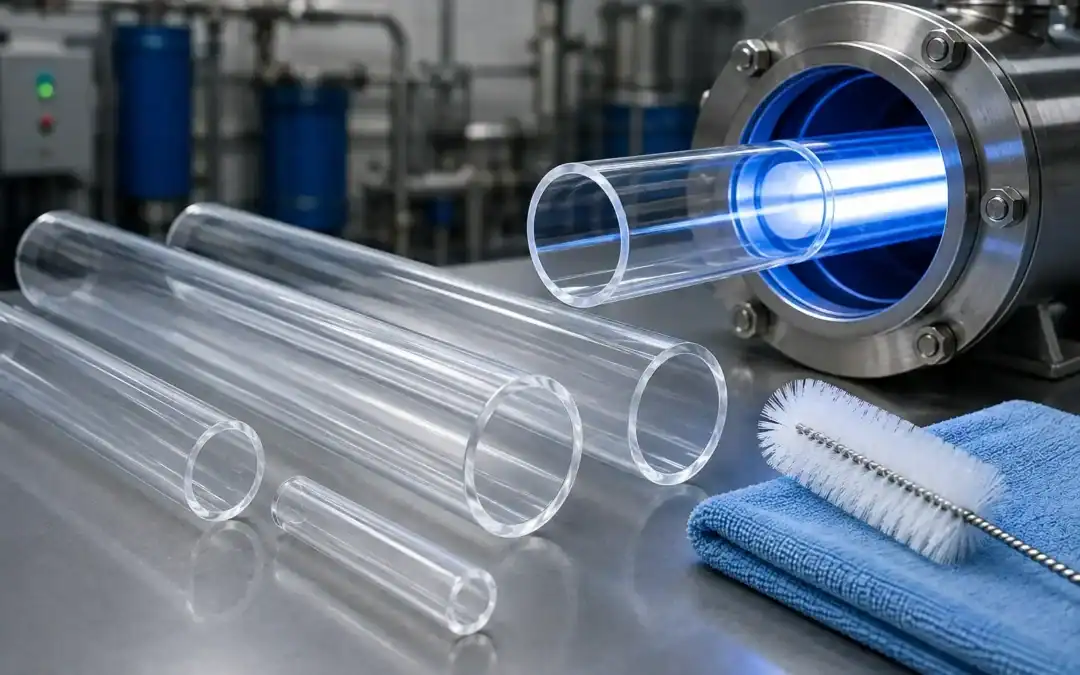
Quartz sleeves are a small but essential component of many ultraviolet water treatment, air purification and germicidal systems. Although the UV lamp produces the ultraviolet light, the sleeve surrounding it has an important job: protecting the lamp while allowing UV-C light to pass through effectively.
For businesses, facilities and homeowners using UV systems, understanding how UV quartz sleeves work can help maintain reliable performance and avoid unnecessary downtime. Choosing the correct sleeve, keeping it clean and replacing it when required can all contribute to efficient UV operation.
ELC Lamps Online supplies a comprehensive selection of quartz sleeves for UV lamps, including different lengths, diameters and configurations for a wide range of UV systems.
What Is a Quartz Sleeve?
A quartz sleeve, sometimes called a quartz jacket or UV lamp quartz tube, is a transparent cylindrical tube positioned around a UV lamp. In water-treatment applications, it creates a physical barrier between the electrical UV lamp and the water flowing through the treatment chamber.
Quartz is used because high-quality quartz glass provides excellent transmission of UV-C light while offering the protection required in demanding UV applications.
The sleeve can help protect the UV lamp against:
- Direct contact with water
- Water flow and pressure
- Temperature fluctuations
- Contamination and deposits
- Accidental environmental exposure
ELC Lamps Online supplies sleeves manufactured from high-quality quartz glass to aid UV-C transmission and protect lamps in applications including water disinfection and air purification.
Why Are Quartz Sleeves Important in UV Systems?
A UV system depends on sufficient ultraviolet energy reaching the target area. In a water disinfection system, that means UV-C light must travel from the lamp, through the quartz sleeve and into the surrounding water.
The transparency and condition of the sleeve therefore matter.
Minerals, scales and other contaminants can gradually accumulate on a sleeve. Even when the UV lamp itself is operating, contamination on the quartz can obstruct UV-C transmission and potentially reduce system effectiveness.
This makes quartz sleeve inspection and cleaning an important part of routine UV system maintenance.
Common Uses of UV Quartz Sleeves
Quartz sleeves for UV lamps are found in numerous commercial, industrial and domestic applications. Common examples include:
- Drinking-water UV treatment systems
- Pond and aquarium UV units
- Commercial water disinfection equipment
- Air purification systems
- Germicidal UV installations
- Industrial UV treatment equipment
The exact sleeve required depends on the UV system and lamp being used. Length, external diameter, end design and sealing arrangement all need to be considered before ordering a replacement.
Types of Quartz Sleeves
Not every UV lamp quartz tube is interchangeable. Several characteristics distinguish one sleeve from another.
Open-Ended Quartz Sleeves
Some sleeves are open at both ends. For example, ELC Lamps Online’s QS-001 is a 330 mm long, 23 mm external-diameter replacement sleeve with both ends open and is designed for specified Sterilight and Viqua UV systems.
Domed-End Quartz Sleeves
Other designs have one sealed or domed end. This configuration is used in various UV systems where the lamp is inserted from one side.
The QS-200, for example, is a 332 mm sleeve with a 23 mm external diameter and one domed end.
Different Diameters and Lengths
Compatibility is not determined by wattage alone. Quartz sleeves are available in numerous lengths and diameters.
ELC Lamps Online stocks a wide selection and can supply sleeves with different lengths, diameters and wall thicknesses, as well as open or domed configurations.
How to Choose Replacement Quartz Sleeves
Ordering replacement quartz sleeves based only on their general appearance can result in an incorrect fit. A few millimetres can make an important difference.
Before purchasing, identify:
- UV system manufacturer and model – This is often the quickest way to identify compatibility.
- Existing sleeve length – Measure carefully in millimetres.
- External diameter – Confirm the outside diameter of the quartz.
- End configuration – Determine whether the sleeve is open-ended, open at both ends or domed.
- UV lamp model – Knowing the installed lamp can help identify the appropriate sleeve.
- O-ring requirements – Check whether new seals are required when installing the sleeve.
ELC Lamps Online advises customers who are identifying an unknown sleeve to establish its length, external diameter and whether it has an open or domed end. The UV system model can also help identify the correct product.
How to Clean Quartz Sleeves
Regular cleaning helps maintain UV-C transmission. The appropriate maintenance interval depends heavily on the water quality and operating environment.
Several ELC replacement sleeves specify cleaning every 6–12 months, depending on water quality. Product guidance also identifies vinegar or a suitable calcium/lime remover as potential cleaning solutions.
When maintaining a UV system:
- Switch off and isolate the system according to the manufacturer’s instructions.
- Allow the lamp and system to cool.
- Handle the quartz carefully because it is fragile.
- Remove mineral deposits without using abrasive materials that could scratch the surface.
- Inspect the sleeve for cracks, chips or cloudiness.
- Check seals and O-rings before reassembly.
- Follow the UV system manufacturer’s installation and maintenance instructions.
Avoid touching clean quartz unnecessarily with bare fingers, and always handle the sleeve carefully during removal and installation.
When Should a Quartz Sleeve Be Replaced?
Cleaning cannot restore every sleeve indefinitely. Over time, persistent deposits, surface deterioration or physical damage may make replacement necessary.
Depending on the particular product and UV system, ELC Lamps Online product guidance commonly recommends replacement at approximately two to three years, while cleaning intervals can be shorter.
Consider replacing a quartz sleeve when:
- It is cracked, chipped or damaged.
- Deposits cannot be completely removed.
- The quartz has become cloudy or visibly deteriorated.
- The sleeve has reached the recommended replacement interval.
- Sealing surfaces have been compromised.
- The UV system manufacturer specifies replacement.
A cracked sleeve in a water-treatment system should receive immediate attention because the sleeve separates the electrical lamp from the water.
Quartz Sleeve Maintenance vs UV Lamp Replacement
The quartz sleeve and UV lamp perform different functions and should be treated as separate maintenance components.
Replacing a UV lamp does not automatically correct poor UV transmission caused by a dirty sleeve. Equally, installing a new sleeve does not restore the declining output of an ageing lamp.
For reliable system performance, maintenance should therefore consider the UV lamp, quartz sleeve and sealing components together.
Why Buy Quartz Sleeves from ELC Lamps Online?
Finding the correct replacement is often more important than simply finding a sleeve with similar dimensions.
ELC Lamps Online offers an extensive range of replacement quartz sleeves for ultraviolet and germicidal lamps, with products covering numerous UV systems and applications. The range includes different lengths, diameters, wall thicknesses and end configurations. Replacement O-rings are also available for suitable applications.
Customers can explore the full Quartz Sleeves product range to identify compatible replacements for water disinfection, pond UV and other UV systems.
Explore Quartz Sleeves: ELC Lamps Online Quartz Sleeves
Frequently Asked Questions About Quartz Sleeves
1. What are quartz sleeves used for?
Quartz sleeves protect UV lamps from direct contact with water and environmental conditions while allowing UV-C radiation to pass through. They are commonly installed in water disinfection, air purification, pond filtration and other germicidal ultraviolet systems requiring protected UV lamps.
2. Why is quartz used around UV lamps?
Quartz is used because high-quality quartz glass provides strong transmission of germicidal UV-C wavelengths while creating a protective barrier around the lamp. Ordinary glass can absorb significantly more ultraviolet radiation, making quartz better suited to many UV disinfection and treatment applications.
3. How often should a quartz sleeve be cleaned?
Cleaning frequency depends mainly on water quality and operating conditions. Many replacement quartz sleeves are recommended for cleaning approximately every six to twelve months. Systems exposed to hard water or substantial mineral deposits may require more frequent inspection and cleaning intervals.
4. When should I replace a quartz sleeve?
Replacement intervals depend on the UV system, sleeve condition and manufacturer recommendations. Many quartz sleeves may require replacement after roughly two to three years. Replace a sleeve sooner when it becomes cracked, chipped, permanently cloudy, heavily scaled or otherwise physically damaged.
5. How do I find the correct replacement quartz sleeve?
Start with the UV system manufacturer, model and existing lamp reference. Then confirm the quartz sleeve’s overall length, external diameter and end configuration. Checking whether O-rings are required will also help ensure the replacement sleeve fits and seals correctly.
6. Can a dirty quartz sleeve reduce UV performance?
Yes. Mineral scale, deposits and contamination on the quartz surface can obstruct UV-C transmission between the lamp and surrounding water. Regular inspection and cleaning therefore help preserve effective light transmission and support the intended performance of the complete ultraviolet treatment system.
7. Are all UV quartz sleeves interchangeable?
No. UV quartz sleeves vary by length, external diameter, wall thickness, end configuration and sealing requirements. Even visually similar products may fit different UV systems. Always verify the system model, lamp reference and sleeve dimensions before ordering a replacement quartz sleeve.
Keep Your UV System Performing Effectively
Quartz sleeves play a crucial role in protecting UV lamps while maintaining effective UV-C transmission. Selecting the correct sleeve, inspecting it regularly, removing deposits and replacing damaged or ageing quartz can help maintain dependable UV system operation.
Whether you need a specific UV lamp quartz tube, compatible UV quartz sleeves or help identifying the correct replacement, ELC Lamps Online offers an extensive specialist range.
Contact ELC Lamps Online today or browse our Quartz Sleeves range to find the right replacement quartz sleeve for your UV system.